Dharamsala is in the northeastern Indian state of Himachal Pradesh, a state known for its mountains and valleys, hill stations, old princely states, local village cultures, and centers of Tibetan culture in exile. This program will take students to a corner of India which has few study abroad programs, at present. It will provide students the opportunity to experience the energy of Tibet’s Buddhist teaching and artistic life as it adapts its traditions to the challenges of exile. Norbulingka Institute for teaching and preserving Tibet’s artistic culture is our collaborator in the project, and will be the site of our classes. Students from any major will learn about Buddhism and Tibetan culture, both theoretically and practically. They will read widely and critically in Tibetan Buddhist philosophical literature. They will have active exchanges with the Tibetan population. Students will have an extraordinary opportunity to become acquainted with a distinctive landscape and material culture. Students will also benefit from the opportunity to contribute to this culture through service learning and active dialog. All students on the program take 2 credits of studio arts titled "Special Topics in Visual Arts: India/Tibet." Within this course, students have the choice of focusing on thangka painting, woodcarving, or applique making - all being taught by local master instructors. In SUMMER 2013, THE FOLLOWING ELECTIVES WILL BE OFFERED: 1. TIBETAN BUDDHIST PHILOSOPHY As brought to global notice by the Dalai Lama and other Tibetan scholars, teachers and practitioners in exile from their homeland, Tibetan Buddhist philosophy is a living tradition featuring a distinctive world view, rigorous analytic argumentation, ethical psychology, and a spiritual technology involving meditation and visualization practice. In the context of our experiential setting in India, we will examine its unique development from its Indian roots, its present role in Tibetan cultural survival, and its application to philosophical questions of identity, moral choice and human purpose and to current ethical issues. Our readings will begin with books by contemporary Tibetan teachers, including the Dalai Lama, and conclude with the middle volume of the classic text, The Great Treatise on the Stages of the Path to Enlightenment (Lam Rim Chen Mo), by the preeminent 14th Century Tibetan philosopher Tsong-Kha-Pa, founder of the Dalai Lama’s Gelug school of Tibetan Buddhism, on the spirit of enlightenment. 2. VISUAL DIARY IN DHARAMSALA A "Visual Diary" is a journal and personal archive, an ideal form for students to capture and record experiences while studying abroad. Using the environment in and around the Norbulingka Institute and Dharamsala, students will learn ways of collecting and organizing their experiences in creative, visual form. Included will be images, observations and impressions on paper. These may be combinations of sketches, drawings, diagrams and maps, notes and writing, collage of found materials and photography which will be shaped into individualized journal/scrap book format. The Visual Diary will compliment the other course work of the program and may serve as reference and memory aid for students' future projects. This course is designed to help students document and absorb the astonishing beauty and new ideas confronted in Dharamsala a daily basis. Upon returning home, the "Visual Diary" can be a precious reminder of a life-changing journey.
Quick Facts
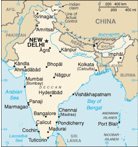
Population: 1205073612 Capital: New Delhi Per-capita GDP: $ 3700 Size: 3287263 km2 Time Zone: (GMT + 05:30 hours) Mumbai, Kolkata, Chennai, New Delhi
US State Department
Travel Warning: YES See : Country Specific Info.